Credit Insurance at the Dealership: Never Required, Frequently Sold
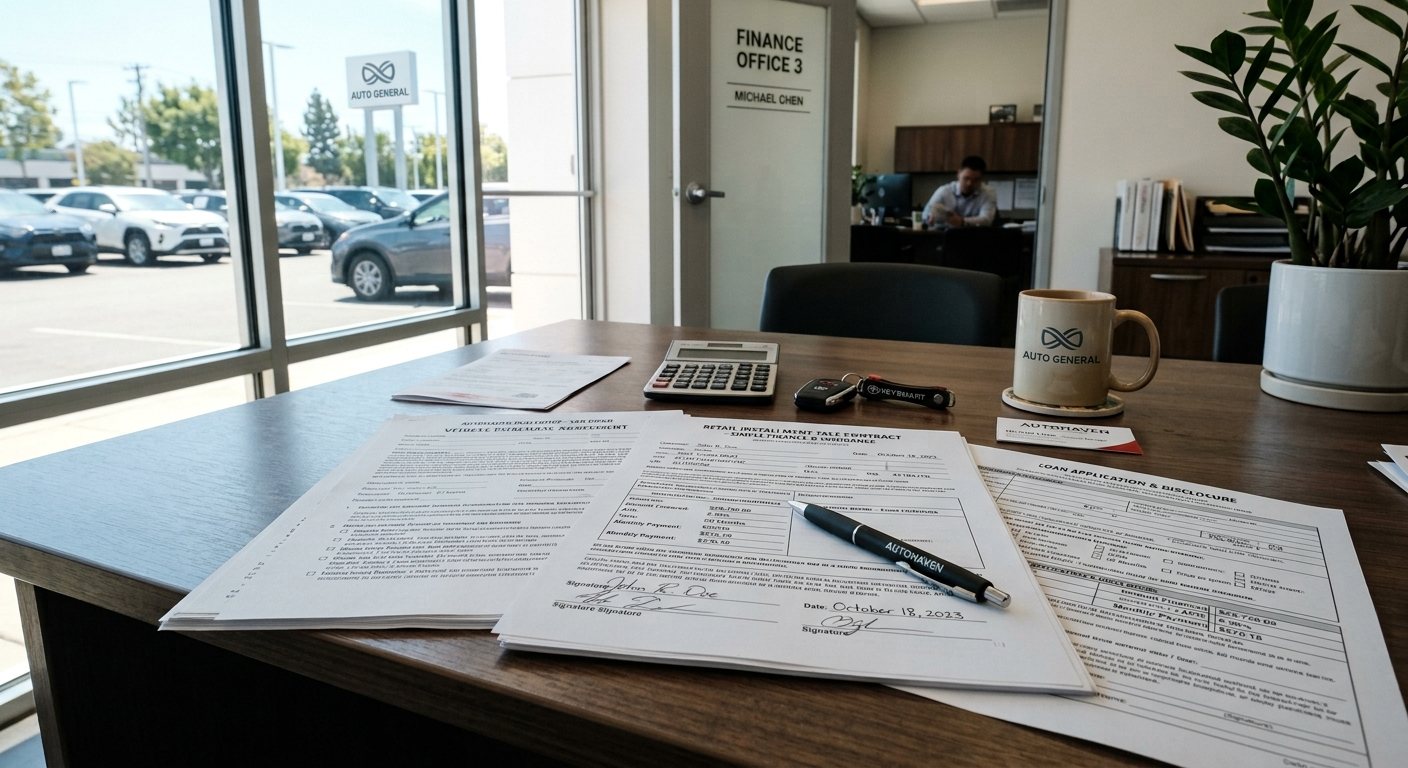
Late in the finance office, after the price is settled and the bigger products have been discussed, a smaller category comes up. Something that pays off your loan if you die. Something that covers payments if you get hurt. Something that helps if you lose your job.
These are credit insurance products, the oldest category in the finance office with a history running close to a century. They are also the category consumer protection sources are most consistently skeptical of.
The single most important thing to know is short: you are never legally required to buy credit insurance to get a car loan. If it is presented as a requirement, that is a red flag, not a rule.
The four products
Credit life insurance pays off your remaining loan balance if you die during the loan term.
Credit disability insurance makes your loan payments if you become ill or injured and cannot work. Typically after a waiting period of 7 to 30 days.
Credit involuntary unemployment insurance makes payments for a limited period if you are laid off.
Credit property insurance covers the vehicle if it is stolen or destroyed. This one is usually redundant with the standard auto insurance you already carry.
Each addresses a real risk. The problem is not the risks. It is the pricing and the way the products get sold.
Why they are consistently flagged
Multiple independent sources, including ValuePenguin, Auto Cheat Sheet, and the Consumer Financial Protection Bureau, describe these products as overpriced relative to standalone term life and disability insurance covering the same events.
The structural reason: credit insurance is sold at the point of a loan, to a captive audience, at a moment when the buyer is already committed. There is no comparison shopping, no underwriting for your individual health, and no incentive to price competitively.
A term life policy covering many times the value of a car loan often costs a healthy person a modest monthly amount. Credit life covering only the declining balance of one auto loan can cost meaningfully more per dollar of protection, and the coverage shrinks as you pay the loan down while the price generally does not.
Sources specifically call out emotional pressure being used to sell involuntary unemployment coverage, which is worth knowing about in advance so you recognize it if it happens.
The coverage you may already have
Before buying any of these, check what you already carry:
Life insurance through an employer. Many people have coverage they have forgotten about, often one or two times salary at no cost. That covers a car loan many times over.
Short-term disability through work. Common in employer benefit packages, and broader than a product that only covers one loan payment.
Your own auto insurance. Comprehensive coverage already handles theft and destruction, which makes credit property insurance largely duplicative.
An emergency fund. If you have several months of expenses saved, that is the same protection these products offer, without a premium.
Buying credit insurance without checking these first is a common way to pay twice for the same protection.
The declining coverage problem
Credit life is tied to your loan balance. It pays off what you still owe.
Which means the coverage shrinks every month as you pay down the loan, while the premium does not shrink with it. By the final year, you may be paying a similar amount to protect a fraction of the original balance.
A standalone term policy holds its face value for the whole term regardless of what you owe on anything, and it is not tied to a single debt.
Financing it makes it worse
As with every finance office product, credit insurance rolled into the loan means paying interest on the premium for the life of the loan. That commonly adds 20 to 35 percent to the real cost.
Some credit insurance is structured as a single premium financed into the loan, which is exactly this problem, and it is worth asking specifically how the premium is being charged.
What to do
Ask directly whether it is required. The answer is no. If you hear anything other than a clear no, that is worth pausing on. Ask which lender requires it and where that requirement is documented.
Do not decide in the finance office. Like everything else there, this is a decision better made in advance with your own information.
Check what you already have first. Employer life insurance, disability coverage, auto comprehensive, savings.
Compare against a standalone quote. If you genuinely want life or disability coverage, get a term insurance quote and compare. That is a fair comparison and it takes very little time.
Read what the disability product actually covers. Waiting periods, maximum benefit duration, and definitions of disability vary considerably and determine whether the product would help at all.
Verify the final paperwork. If you decline, confirm nothing appears on the buyer's order, including bundled or renamed.
If it is presented as a loan condition
This is the part worth being unambiguous about.
No lender requires credit insurance as a condition of loan approval. If a finance manager implies your approval depends on it, or that the bank wants to see it, that is not accurate.
You can ask for the loan without it. You can ask for that in writing. And if the answer changes once you ask directly, you have learned something useful about the rest of the paperwork in front of you.
How DriveTrust handles this
Every add-on is decided and confirmed in writing before our client walks into the finance office, so this conversation has already happened somewhere calm.
If a client declines credit insurance, it is declined in writing beforehand, and we verify the final buyer's order line by line to confirm it has not reappeared under a different name or inside a bundle.
The client is never in the position of evaluating an insurance product for the first time, at the end of a long day, with someone across the desk waiting for an answer.
Common questions
Is credit life insurance required to get a car loan?
No. It is not required by any lender as a condition of approval and is not required by law. It is optional.
What is the difference between credit life insurance and term life insurance?
Credit life covers only your remaining loan balance and pays the lender. Term life covers a fixed amount you choose and pays your beneficiaries, who can use it for anything. Term is generally more coverage per dollar.
Is credit disability insurance worth it?
It depends on whether you already have disability coverage through an employer and how the policy defines disability. Check the waiting period and maximum benefit duration before deciding.
Do I already have this coverage?
Possibly. Employer life insurance, short-term disability benefits, and your auto comprehensive coverage overlap substantially with these products. Check before buying.
Can I cancel credit insurance after signing?
Usually yes, often with a prorated refund, though terms vary by state and provider. Contact the insurer listed on the contract.
What if the finance manager says the bank requires it?
Ask which lender, and ask for that requirement in writing. No lender requires credit insurance for approval.
Rather not do this part yourself?
Every add-on is decided in writing before you reach the finance office, so nothing gets evaluated for the first time at hour four. Book a free consultation and we will walk through your situation.