Extended Warranties: The Markup, the Negotiation Room, and When They Make Sense
The extended warranty is the highest dollar product in most finance offices, and the one where the first number you hear is furthest from the number you could actually pay.
Two facts do most of the work here. First, the price is negotiable, which most buyers never realize. Second, the first offer is deliberately high because it is expected to come down.
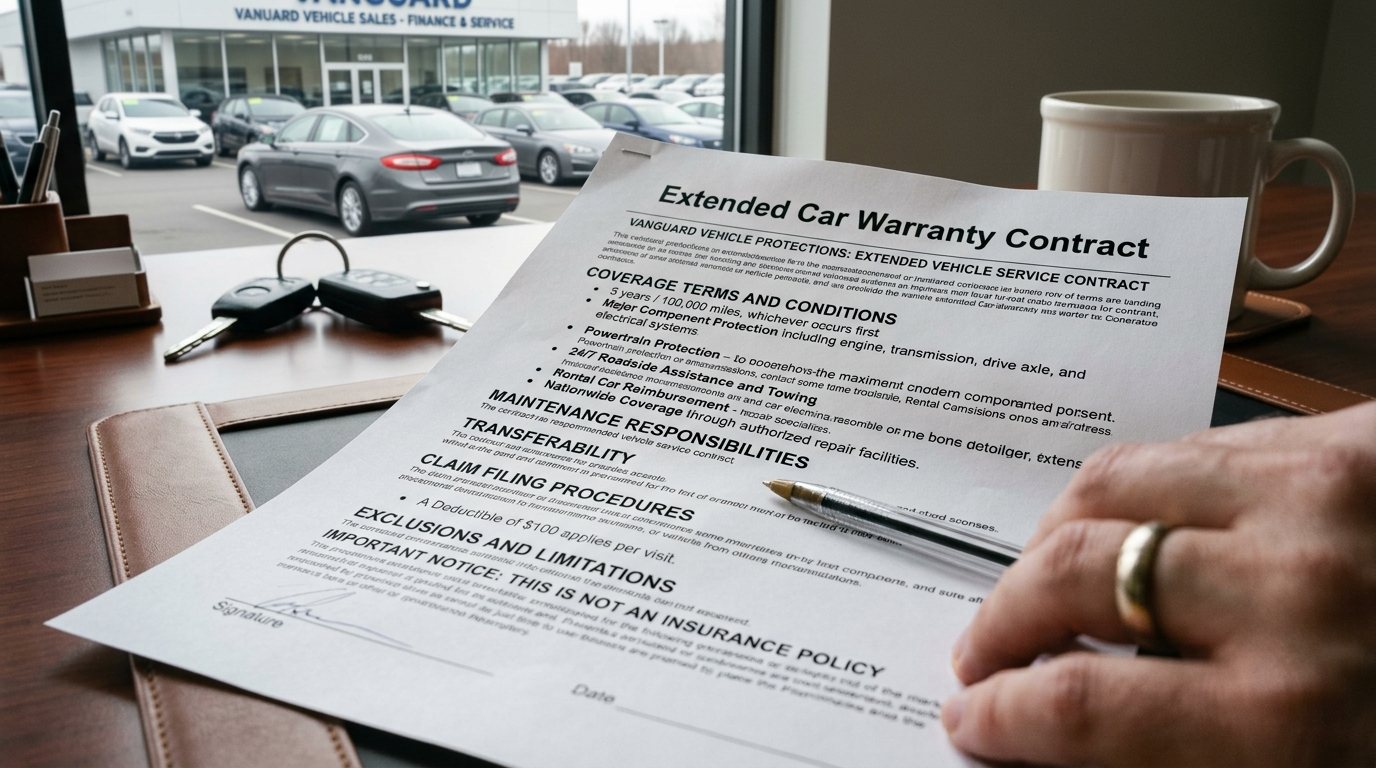
It is not actually a warranty
The product sold as an extended warranty is technically a Vehicle Service Contract, or VSC. The distinction matters more than it sounds.
A warranty comes bundled with the vehicle from the manufacturer at no separate charge. A service contract is a separate product you buy, from either the manufacturer or a third party administrator, that pays for covered repairs after the factory coverage ends.
Knowing the real term is useful for a practical reason: it lets you shop the identical product elsewhere. A manufacturer backed VSC is sold by every dealer of that brand in the country, and they do not all charge the same price for it.
What the pricing actually looks like
Typical total cost runs $1,500 to $4,500 for a multi year contract. Comprehensive coverage on a luxury vehicle can reach $3,000 to $8,000 or more.
Underneath that:
- Dealer markup runs 100 to 200 percent over what comparable coverage costs direct or through third party providers. Manufacturer backed plans mark up less, generally 50 to 75 percent, than pure third party dealer add ons.
- Real negotiation room sits around 25 to 40 percent off the first offer. This is widely reported and consistent across sources.
That second number is the actionable one. The finance office opens high specifically because the price is expected to move. A buyer who accepts the first figure is paying a price nobody expected them to pay.
The three coverage tiers
Not all service contracts cover the same things, and the tier matters as much as the price:
Powertrain is the cheapest. Engine, transmission, drivetrain. The expensive core components, nothing else.
Stated component sits in the middle. Covers a specific listed set of parts. Anything not on the list is not covered, so the list is worth actually reading.
Bumper to bumper is the most expensive and broadest, though it is never literally everything. Wear items and maintenance are typically excluded regardless of tier.
A cheap contract that excludes the failure you eventually have is not a bargain. Comparing price across tiers without comparing what each tier covers is comparing nothing.
Financing it makes it cost more
Same mechanic as every other finance office product: rolled into the loan means paying interest on it for the full loan term.
A $3,000 service contract financed across 72 months does not cost $3,000. Depending on your rate, the real number commonly lands 20 to 35 percent higher.
If you decide you want the coverage, paying for it separately rather than folding it into the loan removes that interest entirely.
EV and hybrid coverage is its own category
If you are buying electric or hybrid, the calculation shifts.
The high voltage battery pack is the single most expensive component to fail outside of warranty. Real replacement costs land in ranges like $16,000 to $22,000 for some Tesla battery modules, $7,500 to $12,000 for a Chevy Bolt drive unit, and $2,500 to $4,500 for a Prius hybrid battery.
EV specific contracts cover components gas vehicles do not have at all: electric drive motors, inverters, DC to DC converters, onboard chargers, regenerative braking systems, and on hybrids the power split device.
EV and hybrid coverage historically ran 40 to 60 percent more than equivalent gas coverage, though that gap has been narrowing as repair cost data matures.
Before assuming you need third party coverage, check the manufacturer's own battery warranty terms for your specific model. Battery warranties are often longer than the general vehicle warranty, and some manufacturers have been expanding their own battery coverage programs. The coverage you are being sold may overlap substantially with coverage you already have.
When a service contract genuinely makes sense
It is a reasonable purchase when:
- You plan to keep the vehicle well past the factory warranty period
- The model has documented reliability issues or expensive known failure points
- A sudden four figure repair bill would be a genuine financial problem
- You are buying a vehicle with complex, expensive systems
It makes less sense when:
- You typically trade or sell before the factory warranty expires
- The vehicle has a strong reliability record
- You could absorb a repair bill without difficulty
- The contract price approaches what you would realistically spend on repairs anyway
There is no universal answer here. It depends on the vehicle, how long you keep cars, and your own tolerance for a surprise bill. What is universal is that the first price quoted is not the real price.
How to handle the conversation
Decide before you go in. Not in the finance office at the end of a long day. Know in advance whether you want the coverage at all.
If you want it, ask for the price to come down. Not aggressively. Just ask. With 25 to 40 percent typical negotiation room, this single question is worth more per minute than almost anything else you will do that day.
Ask what the dealer's cost is. You may not get a straight answer, but asking establishes that you know there is a spread.
Cross shop the identical product. For a manufacturer backed contract, another dealer of the same brand sells the same thing, sometimes for meaningfully less.
Read the exclusions before the price. What is not covered determines whether the price means anything at all.
Pay separately rather than financing if you can, to avoid paying interest on it.
How DriveTrust handles this
Add ons get settled before our client reaches the finance office, in writing, as part of the deal itself.
If a client wants a service contract, we negotiate the price as part of the overall deal rather than leaving it to be handled under pressure at the end. If they do not want it, it is declined in writing beforehand, and we verify the final buyer's order to confirm nothing declined has quietly reappeared under a different name or inside a bundle.
The client's decision does not change. What changes is when and how it gets made: calmly, with real numbers, instead of at hour four with someone waiting for an answer.
Common questions
Is an extended warranty negotiable?
Yes. Typical negotiation room runs 25 to 40 percent off the first offer. The opening price assumes you will ask.
Do I have to buy it from the dealership?
No. Manufacturer backed contracts are available from any dealer of that brand, and third party providers sell comparable coverage independently. You can also buy one later, though pricing generally rises as the vehicle ages.
Is it required for financing?
No. No lender requires a service contract as a condition of loan approval.
Can I cancel it after signing?
Generally yes, with a prorated refund, though terms vary by provider and state. Check the cancellation section of the contract itself.
Does an extended warranty cover maintenance?
No. Oil changes, brakes, tires, and other wear and maintenance items are excluded. That is a separate product, a prepaid maintenance plan.
Is a third party contract as good as a manufacturer one?
It depends heavily on the administrator. Manufacturer backed contracts are generally honored at any dealer of that brand and tend to have simpler claims processes. Third party contracts vary widely in quality and in which shops will accept them.
Rather not do this part yourself?
We negotiate add ons as part of the overall deal, in writing, before you reach the finance office. Book a free consultation and we will walk through your situation.