When the Advertised Price Is Not the Price: What the FTC Told 97 Dealer Groups
You find the vehicle online. The listing says $48,675. You call to buy it.
The price is $58,675.
In most retail, this would be unthinkable. A television listed at $999 does not become $1,499 when you reach the register. In vehicle sales it is common enough that the Federal Trade Commission addressed it directly.
What the FTC actually did
In March 2026, the FTC sent warning letters to 97 auto dealership groups stating that advertised vehicle prices must reflect the total price a consumer will be required to pay, excluding only government charges such as taxes.
The letters identified specific practices the agency considers deceptive:
- Advertising a price that omits required dealer fees
- Advertising prices built on rebates or discounts not available to all consumers
- Advertising prices that do not account for a required down payment
- Conditioning an advertised price on the buyer using dealer financing
- Requiring buyers to purchase add-ons not included in the advertised price
- Advertising vehicles that are unavailable or do not exist
The stated basis is Section 5 of the FTC Act, which prohibits unfair or deceptive acts and practices.
What it is not
Being precise here matters, because overstating it will get you corrected by a dealer who knows the details.
These are warning letters, not a rule. There is no compliance deadline and no automatic penalty attached. The FTC stated it would continue monitoring and take further action as warranted, and the letters expressly note they are not a determination that any recipient violated the law.
The earlier rule was abandoned. A previous federal effort to regulate dealer pricing and add-ons more formally did not survive. What replaced it is enforcement posture under existing law rather than a new rulebook.
So the accurate framing is: the FTC has publicly stated that advertising a price below what you actually charge is potentially deceptive, and has put a large portion of the industry on notice. That is real and citable. It is not a statute with a penalty schedule.
State law is separate and sometimes stronger. Several states have their own advertising and disclosure rules for vehicle sales, and some are more specific than the federal position. Worth checking your own state, since local rules may give you more to work with.
The two stickers
Much of the confusion here is structural, and it starts on the vehicle's window.
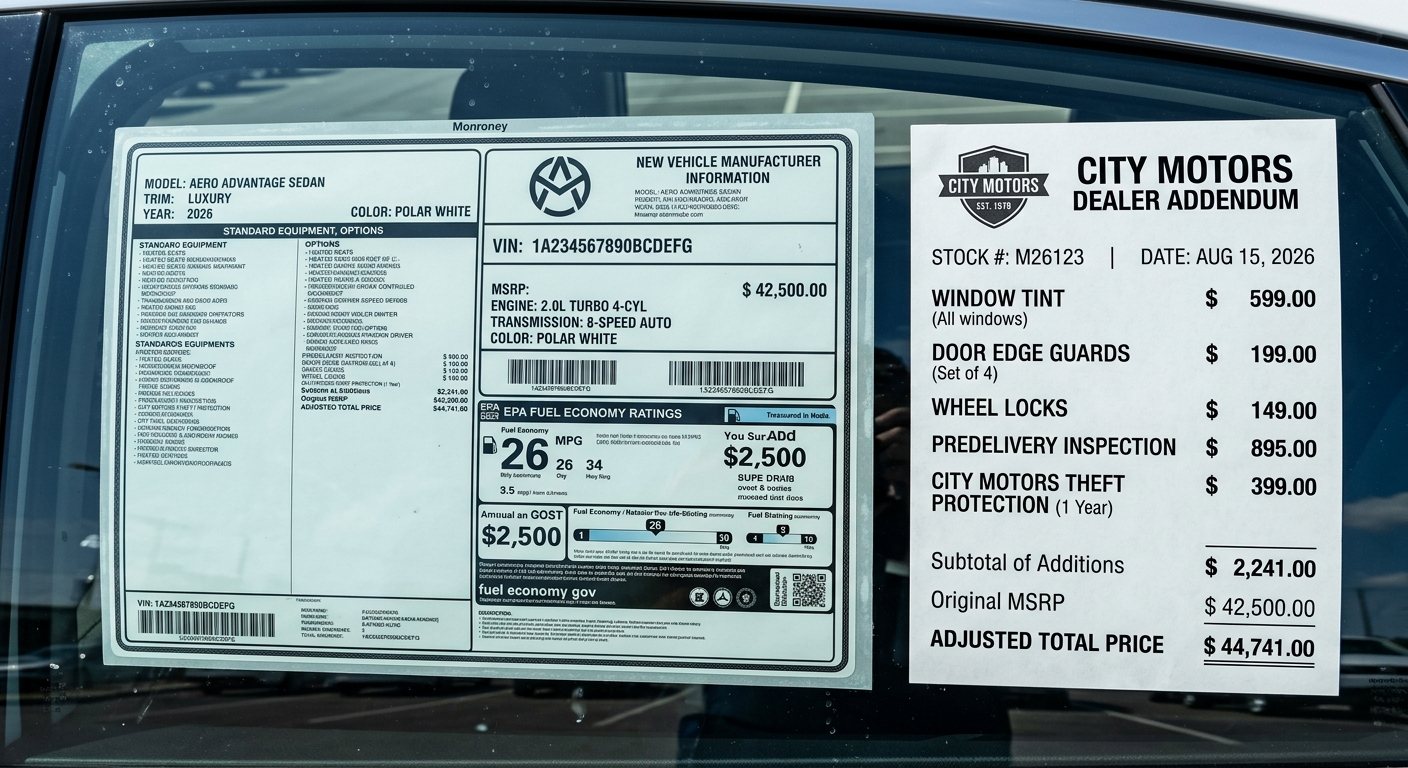
The Monroney sticker is the factory window sticker, required by federal law. It lists MSRP, factory options, fuel economy, and where the vehicle was assembled. It is the manufacturer's document.
The addendum sticker is the dealer's own additional sticker. It lists dealer-installed options and any market adjustment. Everything on it was priced by the dealership.
When someone says "the sticker price," they may mean either. The gap between them is where dealer-added money lives, and it is entirely negotiable in a way factory content is not.
The sophisticated version
The obvious version of this problem is a listing that simply omits a markup. There is a more refined version worth recognizing.
Some dealers fold the documentation fee into the advertised price. The listing shows MSRP plus doc fee and calls the result an internet price or net price. To anyone who knows the FTC guidance, that looks like compliance: fees included, nothing hidden.
Then the call reveals a market adjustment of several thousand dollars that never appeared anywhere on the listing.
Including the small mandatory fee while omitting the large one is not evidence of honest pricing. It sometimes indicates the opposite, that the dealer is aware of the expectation and is working around it.
The fine print defense
When challenged, the standard response is a disclaimer. Common versions:
- "Price does not include dealer added markups"
- "Pricing is continually reviewed using current market conditions"
- "Published price subject to change without notice"
- "Price good for 2 days only"
Two things to know about this.
The FTC's stated position is about the advertised price itself, not about whether a disclaimer exists somewhere on the page. A disclaimer that contradicts the headline number does not resolve the problem the guidance describes.
Read the fine print anyway, carefully, because it frequently helps you. Dealer disclaimers are often boilerplate and sometimes say the opposite of what the dealer claims on the phone. Language stating that the online price includes applicable dealer-installed options and dealer fees appears on plenty of listings whose staff will tell you the advertised figure was "just MSRP." Reading their own language back to them is more effective than citing a federal agency.
What to do
Screenshot the listing before you call. The full page, including the fine print. Prices change and listings get edited.
Ask for the out-the-door price in writing on the specific stock number. Every line: vehicle price, every dealer fee, every add-on, tax, title, registration.
Compare it to the listing line by line. Any difference should be explainable in one sentence.
Ask what the difference is if there is one, and ask for it itemized. Market adjustments and dealer-installed accessories are two different things and should be separated.
Read their own disclaimer back to them if it contradicts what you are being told.
Cite the guidance accurately if you cite it at all. "The FTC sent letters to 97 dealer groups in March saying advertised prices have to be the total price" is correct and defensible. "It is illegal" overstates it and invites a correction that costs you credibility mid-conversation.
Move on if it does not resolve. The strongest response is not an argument, it is a written quote from another store on the same vehicle.
When the markup is real
Worth saying plainly: a dealer is generally allowed to charge above MSRP. On a genuinely scarce vehicle, demand is real and so is the price.
The issue in the FTC's letters is not the markup, it is advertising one price and charging another. A dealer who lists a vehicle at $10,000 over MSRP, openly, has done nothing deceptive. You can decide whether it is worth it.
If a vehicle you want is scarce in your region, distance is usually the better lever than argument. The same configuration frequently sits on lots elsewhere at ordinary pricing, and manufacturers build specific color and option combinations for specific regions, so a car nobody stocked near you may be common a few states over.
How DriveTrust handles this
We request written out-the-door pricing on the specific stock number from multiple dealers before any client commits to anything, which surfaces a gap between listed and real pricing immediately rather than at signing.
We also compare across a wide geographic radius, because on a vehicle carrying a real market adjustment locally, the answer is often a different store rather than a better argument.
The client never has to be the person on the phone reading fine print back to a sales manager.
Common questions
Do dealers have to honor their advertised online price?
The FTC's March 2026 letters state that advertised prices must reflect the total price a consumer will pay, excluding government charges. These are warning letters signaling enforcement posture under Section 5 of the FTC Act rather than a rule with penalties, and state advertising laws may apply separately.
Is a dealer markup over MSRP legal?
Generally yes. MSRP is a suggested price. The FTC concern is advertising one price and charging another, not the markup itself.
What is a market adjustment?
An amount added above MSRP because of demand. It is not a product and has no cost behind it. It appears on the dealer's addendum sticker, not the factory window sticker.
What is the difference between the window sticker and the addendum?
The Monroney window sticker is federally required and comes from the manufacturer, listing MSRP and factory options. The addendum is the dealer's own sticker listing dealer-installed items and any market adjustment.
Does fine print let a dealer advertise a lower price?
The FTC's stated position addresses the advertised price itself rather than whether a disclaimer appears elsewhere on the page. Read the fine print regardless, since it often contradicts what you are told on the phone.
What should I do if a dealer will not honor the advertised price?
Ask for the out-the-door price in writing and an itemized explanation of the difference. Then get written quotes from other dealers on the same vehicle. A competing written offer moves a price more reliably than an argument does.
Can I report a dealer to the FTC?
Yes, complaints can be filed with the FTC and with your state attorney general or consumer protection office.
Rather not do this part yourself?
We request written out-the-door pricing on the specific stock number from multiple dealers, so a listing gap surfaces immediately. Book a free consultation and we will walk through your situation.