Car Dealer Doc Fees by State: What's Normal, What's a Red Flag

Two buyers walk into two different dealerships on the same day, buying the exact same car at the exact same price.
One of them pays $85 for a line item called the "doc fee." The other pays close to $900 for the exact same paperwork. Neither dealer did anything wrong where they operate. That is just how uneven the rules are from one state to the next.
If you have never heard of a doc fee before your finance office visit, here is what it is, why it swings so wildly by state, and what you can actually do about it.
What a doc fee actually covers
A documentation fee, almost always shortened to "doc fee," is what a dealer charges to prepare and process the paperwork tied to your sale: the title transfer, the registration filing, the loan documents if you are financing, and the various forms sent to your state's motor vehicle agency. It is separate from tax, title, and registration costs themselves, which go to the state, not the dealer.
Here is the part that surprises most buyers: the actual labor and materials behind that paperwork cost the dealer very little, commonly estimated at well under $50. The rest of whatever you are charged is margin. That does not make the fee illegal. It makes it one of the more profitable line items on your purchase agreement, dressed up as an administrative pass-through.
Why the same fee costs $85 in one state and $900 in another
The doc fee is not set by any single national rule. Each state decides on its own whether to regulate it, and the approaches vary a lot:
- Some states cap it outright. A law sets a hard ceiling every dealer in that state has to follow. California is a good example, with one of the lowest caps in the country.
- Some states index the cap to inflation. A handful of states let the cap adjust automatically each year rather than requiring new legislation every time.
- Many states do not regulate it at all. In these states, each dealer sets its own doc fee, and it can vary significantly even between two dealers a few miles apart.
That patchwork is why the same paperwork can cost you under $100 in one state and close to four figures in another. States that leave the fee unregulated, including Florida and Virginia, are consistently reported among the most expensive in the country, with dealers commonly charging several hundred dollars and sometimes more.
Utah, where DriveTrust is based, falls into the unregulated category. There is no statutory cap here, so the fee is entirely up to the dealer.
States that cap the doc fee
Roughly a third of states set a legal maximum. A few examples of how differently those caps land:
- California has one of the lowest caps in the country, in the neighborhood of $85.
- Washington caps the fee at $200 under state law.
- Texas does not have a hard statutory cap, but state regulators set a "safe harbor" amount, historically in the $150 to $225 range, above which a dealer needs to be able to justify the charge.
- West Virginia caps the fee in the mid-$500s, with the cap indexed to inflation so it moves slightly each year.
Caps like these change periodically, sometimes automatically. Treat any specific number here as a starting point for what to expect, not a figure to quote back to a dealer as gospel. Confirm your own state's current cap before you go in.
States with no cap at all
In uncapped states, the doc fee is whatever the dealer decides to charge, with no legal ceiling stopping it from climbing. Florida and Virginia show up again and again in industry reporting as the most expensive markets in the country, with average doc fees commonly cited in the $600 to $900+ range, and some dealers charging well above that. Georgia and Colorado also tend to run higher than the national norm.
If you are buying in one of these states, the fee itself is not something you can point to a law and dispute. That does not mean it is untouchable, though.
Is the doc fee negotiable?
Here is the twist: in states that cap the fee by law, the dealer is usually required to charge every customer the same amount. That means you personally cannot talk a capped doc fee down, since the dealer is not legally allowed to give you a different number than the next buyer.
In uncapped states, the fee is technically set by the dealer, but most dealers still treat it as fixed once it is printed on their standard paperwork. Fighting the doc fee as its own line item rarely works, in either kind of state.
The real move: negotiate the out-the-door number, not the line item
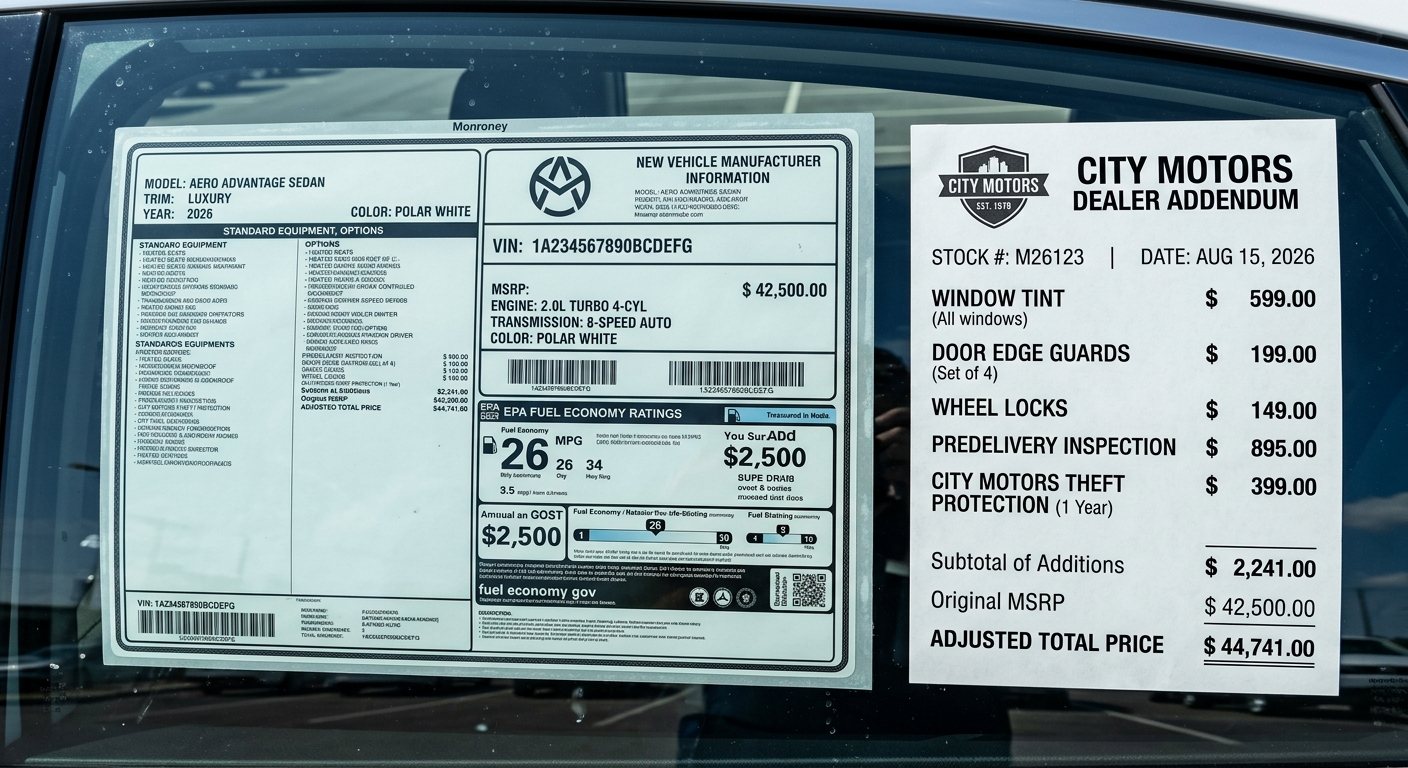
The doc fee matters less as a standalone number and more as one piece of your full out-the-door price, the total you will actually pay once every fee and every tax is included. If a dealer's doc fee runs high for your market, the counter is not to argue the fee itself. It is to ask for a lower vehicle price that offsets it, so your final number still lands where it should.
This is also where a doc fee hiding on a website listing becomes a useful signal, not just an annoyance. A dealer who lists a doc fee openly is at least showing you a real number up front. One who buries it until the finance office, or advertises a price that conveniently omits it, is a different kind of red flag entirely.
How DriveTrust handles this
By the time one of our clients sits down to sign, the doc fee for their specific dealer is already known, already built into the negotiated out-the-door number, and never a surprise waiting in the finance office. That is the difference between finding out what a fee costs after you have committed to a car, and knowing it before you ever pick up the phone.
Common questions
What is a car dealer doc fee?
A documentation fee is a charge dealers add to cover the paperwork involved in a vehicle sale, including title transfer, registration filing, and loan documents. It is separate from state taxes and registration costs.
Can I refuse to pay the doc fee?
In most states, no. It is a standard part of the dealer's purchase agreement, whether it is capped by law or set by the dealer. What you can do is negotiate the total out-the-door price to account for it.
Which states have the lowest doc fees?
States with strict legal caps tend to have the lowest fees, with California consistently reported as one of the lowest in the country.
Which states have the highest doc fees?
States without any cap tend to run the highest, with Florida and Virginia repeatedly showing up at the top of industry reporting, often in the several-hundred-dollar range or more.
Is a $900 doc fee legal?
In an uncapped state, yes. The fee is not limited by law there, so a dealer can set it wherever they choose. In a capped state, a fee above the legal limit would not be.
Why did my doc fee change from what I saw online?
Some dealers advertise a price that does not include the doc fee, then add it once you are further into the process. Always ask for the full out-the-door number in writing before you agree to anything.
Rather not do this part yourself?
We confirm the doc fee for your specific dealer up front and build it into the negotiated out-the-door number, so nothing new appears in the finance office. Book a free consultation and we will walk through your situation.