Low APR or the Cash Rebate? Running the Math on Which to Take
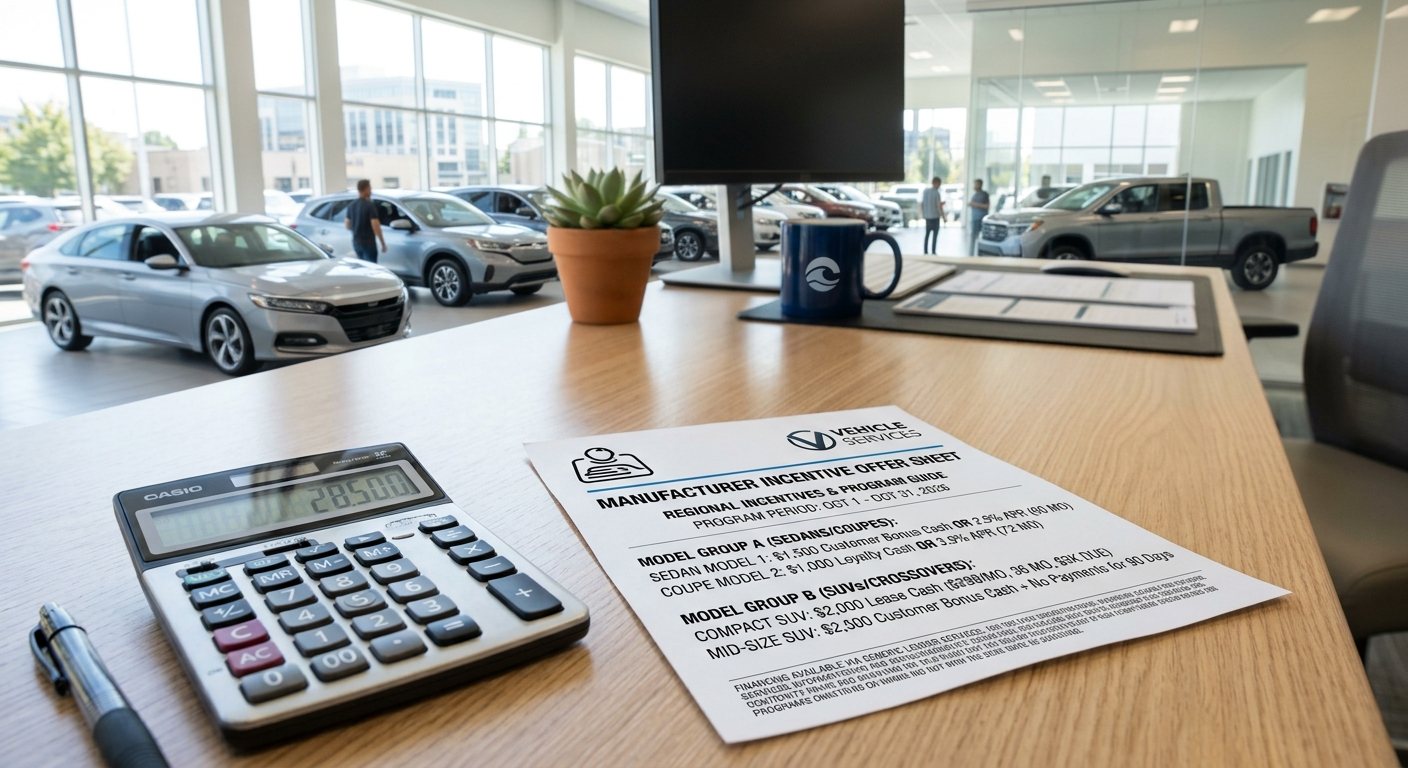
The advertisement says 1.9% APR or $3,500 customer cash.
That "or" is the part people skim past, and it is the whole decision. You are being asked to choose between money off the price and money off the interest, and which is worth more depends entirely on numbers specific to you.
Fifteen minutes of arithmetic decides it. Here is how to do it.
Why you usually have to choose
Both offers come from the manufacturer, not the dealer. They are sales tools, funded by the automaker to move a specific model.
Promotional APR works by the manufacturer subsidizing the captive lender to write loans below market rates. Customer cash works by the manufacturer handing money toward your purchase price.
Manufacturers rarely fund both on the same vehicle because both cost them the same thing. Hence either/or.
Two conditions come attached and both matter:
Promotional APR generally requires the captive lender. You cannot take Toyota's subsidized rate through your credit union. That is the mechanism.
Cash incentives are frequently contingent on financing through the captive too. This surprises people. "Purchase cash" or a "financing allowance" often requires you to finance through the manufacturer's arm, meaning a cash buyer may not qualify for it at all. Ask specifically.
The math
You are comparing total cost of the loan under each option.
Option A, promotional APR: finance the full price at the low rate.
Option B, cash rebate: subtract the rebate from the price, then finance the smaller balance at whatever rate you can actually get, which is your credit union rate or the dealer's non-promotional rate.
Total cost under each is the sum of all payments. Whichever is lower wins.
Worked example. A $40,000 vehicle, 60 months, comparing 1.9% APR against $3,500 cash with outside financing at 6.5%.
Option A: $40,000 at 1.9% over 60 months. Payment lands around $699, total paid roughly $41,940. Interest cost about $1,940.
Option B: $36,500 at 6.5% over 60 months. Payment lands around $714, total paid roughly $42,840. Interest cost about $6,340.
Option A wins by about $900 despite the rebate looking bigger up front, because five years of a four and a half point rate gap on a large balance outweighs a one-time $3,500.
Now change one variable. Same vehicle, same rebate, but a 36-month term.
Option A: $40,000 at 1.9% over 36 months, total paid roughly $41,170.
Option B: $36,500 at 6.5% over 36 months, total paid roughly $40,270.
Option B now wins by about $900. Shorter term means less time for the rate advantage to accumulate, so the flat rebate dominates.
Same car, same offers, opposite answer. The term flipped it.
What tilts each way
The cash rebate tends to win when:
- Your loan term is short
- Your own financing rate is already competitive
- The rebate is large relative to the vehicle price
- You are putting a lot down, so the financed balance is small
- You plan to pay the loan off early
The promotional APR tends to win when:
- Your loan term is long, five years or more
- Your alternative rate is high
- The rebate is modest
- You are financing most of the purchase price
The underlying logic: a rate advantage compounds over time and over balance. A rebate is a fixed amount. The longer and larger the loan, the more the rate matters.
Two things that change the calculation
A cash purchase. If you are not financing at all, promotional APR is worth nothing to you. Take the rebate, and confirm you qualify for it as a cash buyer, since some cash incentives require captive financing.
Credit tier. Advertised promotional rates are for top-tier credit. If you do not qualify for the advertised rate, the comparison changes entirely, and it is worth asking what rate you actually qualify for before assuming the promotion applies to you.
Stacking, and what actually does stack
While APR and cash usually do not combine, other incentives frequently do:
- Conquest cash, for buyers coming from a competing brand
- Loyalty cash, for buyers already in the brand
- Military, first responder, and recent graduate programs
- Regional incentives, which vary by market
These are often based on the vehicle currently in your driveway or your occupation, and they generally layer on top of both the promotional rate and the dealer's own discount.
Which means the question at intake is not "what is the rebate," it is "which programs do I qualify for," and it is worth having your current vehicle registration handy when you ask.
Keep it separate from the discount
The most important framing point in this whole article.
Manufacturer incentive spending reached 6.6% of MSRP in August 2026, an average of $3,384 per vehicle against an average transaction price of $45,563, according to J.D. Power.
That money is on the vehicle before anyone negotiates. It comes from the manufacturer, not the dealership.
So a dealer presenting the factory incentive as though it were their concession has not actually discounted anything. Ask for the factory incentives and the dealer discount as two separate numbers, in writing. If a first offer does not clear the available factory money on its own, the negotiation has not started yet.
What to do
Find out what is actually available on your specific vehicle, in your region, this month. Manufacturer incentive pages list current programs, and they change monthly.
Ask which are either/or and which stack, and get the answer in writing.
Get your own pre-approval so you know the real Option B rate rather than guessing.
Run both totals. Any online auto loan calculator does this in a few minutes.
Confirm your credit tier qualifies for the advertised promotional rate.
Ask for factory money and dealer discount separately so you can see what the store actually gave up.
How DriveTrust handles this
We confirm in writing which manufacturer programs apply to the specific vehicle, which stack, and which are either/or, because the answer varies by model, region, and month and is frequently answered inconsistently.
We also insist on seeing the factory incentives and the dealer discount as separate lines, which makes it visible whether a store has actually moved off its price or simply passed along money the manufacturer was already providing.
Then we run the comparison both ways on the client's real loan amount, term, and rate, so the choice is made on arithmetic rather than on which number sounds larger.
Common questions
Can I get both the low APR and the cash rebate?
Usually not. Manufacturers typically fund one or the other on a given vehicle. Ask specifically, since it occasionally varies by model and region.
Which is better, 0% APR or a cash rebate?
It depends on your loan amount, term, and alternative rate. Longer terms and larger balances favor the low APR. Short terms, large down payments, and cash purchases favor the rebate. Run both totals.
Do I have to finance through the manufacturer to get the rebate?
Frequently yes. Many customer cash offers are contingent on captive financing, which can exclude cash buyers. Confirm before assuming.
Can I take the rebate and then refinance elsewhere?
Often yes, though some incentives carry a minimum financing period. Check the terms, and note that refinancing away from a subsidized promotional rate rarely makes sense.
What if I do not qualify for the advertised APR?
Advertised promotional rates are top-tier only. Ask what rate you actually qualify for before running the comparison, since the whole calculation changes.
Do conquest and loyalty incentives stack with these?
Generally yes. They are separate programs, usually based on the vehicle you currently own, and they typically layer on top of both the rate offer and the dealer discount.
Is the rebate negotiable?
No. Factory incentives are fixed by the manufacturer. The dealer's discount is the negotiable part, which is exactly why they should be quoted as two separate numbers.
Rather not do this part yourself?
We confirm in writing which programs stack and which are either/or, then run the comparison on your real numbers. Book a free consultation and we will walk through your situation.